

Kalam Kitaab
Saheed Jaswant Singh Khalra ( ਸ਼ਹੀਦ ਜਸਵੰਤ ਸਿੰਘ ਖਾਲੜਾ ) Book - Dr. Paramjit Singh Mansa
Saheed Jaswant Singh Khalra ( ਸ਼ਹੀਦ ਜਸਵੰਤ ਸਿੰਘ ਖਾਲੜਾ ) Book - Dr. Paramjit Singh Mansa
Couldn't load pickup availability
Share
"ਸ਼ਹੀਦ ਜਸਵੰਤ ਸਿੰਘ ਖਾਲੜਾ" ਡਾ. ਪਰਮਜੀਤ ਸਿੰਘ ਮਾਨਸਾ ਦੀ ਇੱਕ ਮਹੱਤਵਪੂਰਨ ਪੰਜਾਬੀ ਕਿਤਾਬ ਹੈ ਜੋ ਮਨੁੱਖੀ ਅਧਿਕਾਰਾਂ ਦੇ ਕਾਰਕੁਨ ਅਤੇ ਸ਼ਹੀਦ ਜਸਵੰਤ ਸਿੰਘ ਖਾਲੜਾ ਦੇ ਜੀਵਨ, ਸੰਘਰਸ਼ ਅਤੇ ਮਨੁੱਖਤਾ ਪ੍ਰਤੀ ਸਮਰਪਣ ਨੂੰ ਪਾਠਕਾਂ ਸਾਹਮਣੇ ਲਿਆਉਂਦੀ ਹੈ। ਸ਼ਹੀਦ ਜਸਵੰਤ ਸਿੰਘ ਖਾਲੜਾ ਵਿੱਚ ਖਾਲੜਾ ਜੀ ਦੀ ਮਨੁੱਖੀ ਅਧਿਕਾਰਾਂ ਲਈ ਆਵਾਜ਼, ਨਿਆਂ ਪ੍ਰਤੀ ਦ੍ਰਿੜ੍ਹਤਾ ਅਤੇ ਪੰਜਾਬ ਦੇ ਇੱਕ ਔਖੇ ਦੌਰ ਵਿੱਚ ਉਨ੍ਹਾਂ ਵੱਲੋਂ ਨਿਭਾਈ ਭੂਮਿਕਾ ਬਾਰੇ ਜਾਣਕਾਰੀ ਮਿਲਦੀ ਹੈ। ਇਤਿਹਾਸ, ਮਨੁੱਖੀ ਅਧਿਕਾਰਾਂ ਅਤੇ ਪੰਜਾਬ ਦੇ ਸਮਾਜਿਕ-ਰਾਜਨੀਤਿਕ ਇਤਿਹਾਸ ਵਿੱਚ ਦਿਲਚਸਪੀ ਰੱਖਣ ਵਾਲੇ ਪਾਠਕਾਂ ਲਈ ਸ਼ਹੀਦ ਜਸਵੰਤ ਸਿੰਘ ਖਾਲੜਾ ਇੱਕ ਮਹੱਤਵਪੂਰਨ ਪੜ੍ਹਾਈ ਹੈ।
"Shaheed Jaswant Singh Khalra" by Dr. Paramjit Singh Mansa is a Punjabi work that explores the life, struggles, and human-rights legacy of Jaswant Singh Khalra. The book highlights Khalra's commitment to justice, his advocacy for human rights, and his role during one of the most difficult periods in Punjab's modern history. Shaheed Jaswant Singh Khalra offers readers an opportunity to learn about an important figure associated with human rights and social justice while understanding the historical context surrounding his work and sacrifice. It is a valuable read for those interested in Punjab's history, human rights, and biographical literature.
Book Title: ਸ਼ਹੀਦ ਜਸਵੰਤ ਸਿੰਘ ਖਾਲੜਾ (Shaheed Jaswant Singh Khalra)
Author: Dr. Paramjit Singh Mansa
Language: Punjabi (Gurmukhi)
Genre: Biography / Punjab History / Human Rights / Historical Literature
Available at: Kalam Kitaab
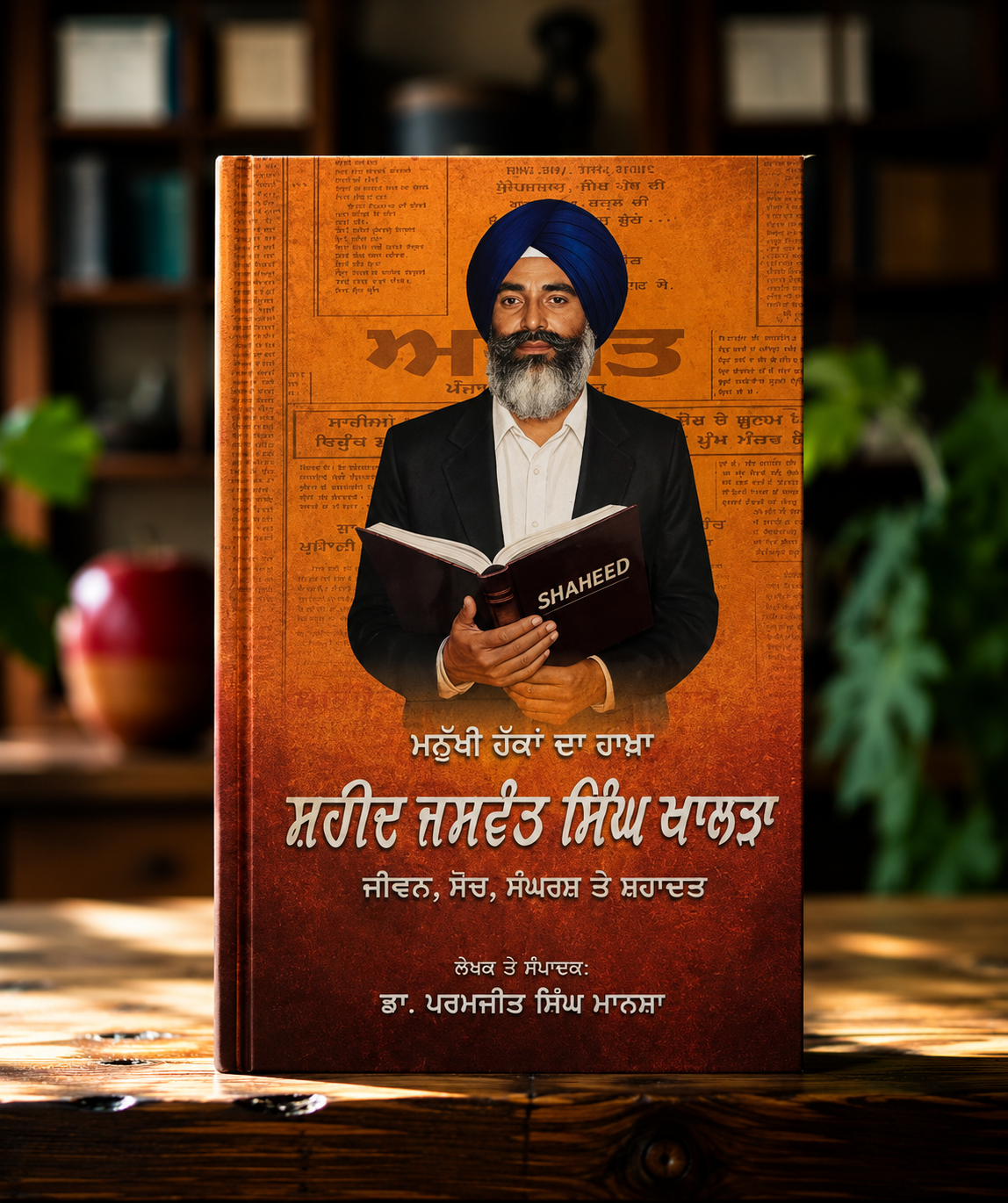
Saheed Jaswant Singh Khalra – Dr. Paramjit Singh Mansa
The Life, Struggle and Legacy of Shaheed Jaswant Singh Khalra
Saheed Jaswant Singh Khalra by Dr. Paramjit Singh Mansa is a Punjabi book centred on the life, struggle, courage and legacy of Jaswant Singh Khalra, one of the most significant human rights activists associated with Punjab's modern history. The book presents the journey of a man who dedicated himself to uncovering truth, documenting human rights concerns and standing for justice during one of the most difficult periods in Punjab's recent past.
Jaswant Singh Khalra's name has become closely associated with courage, human rights, accountability and the preservation of historical truth. His work brought attention to serious allegations concerning disappearances and unidentified cremations in Punjab, making his story an important part of discussions surrounding human rights and justice.
For readers interested in Punjab's history, Sikh history, human rights and biographies of individuals who stood firmly by their principles, Saheed Jaswant Singh Khalra offers an opportunity to explore the life of a remarkable personality through Punjabi literature.
Who Was Jaswant Singh Khalra?
Jaswant Singh Khalra was a human rights activist who became known for his determined efforts to investigate and document cases connected with disappearances and unidentified cremations during the turbulent years of Punjab's modern history.
Before becoming widely recognised for his human rights work, Khalra had worked as a banker. His later research and investigation brought him into the centre of an extremely sensitive and dangerous subject.
Rather than remaining silent in the face of troubling evidence, he pursued documentation and records in an effort to establish what had happened to people whose families were searching for answers.
His work demonstrated the importance of evidence in understanding difficult historical events.
A Life Guided by Principles
The story of Jaswant Singh Khalra is not simply the story of a public activist.
It is also a story about principles.
At a time when asking difficult questions could carry enormous personal risks, Khalra continued his efforts to document information and bring attention to human rights concerns.
His approach reflected the belief that truth must be supported by evidence and that families affected by disappearance and violence deserved answers.
This commitment became one of the defining characteristics of his life.
Punjab's Difficult Period
To understand Khalra's work, it is important to understand the historical environment in which he lived.
Punjab experienced severe political and social turmoil during the 1980s and 1990s. Violence, militancy, counter-insurgency operations, disappearances and allegations of human rights violations created an atmosphere of fear and uncertainty.
Families were often left searching for information about missing relatives.
It was within this difficult environment that Khalra began pursuing documentary evidence.
His work therefore cannot be separated from the wider history of Punjab during this period.
The Importance of Documentation
One of the most important aspects of Khalra's work was documentation.
Instead of relying only on individual accounts or rumours, he examined official records and other available evidence.
Documentation became a means of establishing facts.
Records that might otherwise have remained unnoticed could provide clues about what had happened to individuals and how their cases were treated by institutions.
This emphasis on evidence is an important part of understanding Khalra's contribution.
Giving Families a Voice
Behind every missing person is a family.
A disappearance does not affect only one individual. Parents, spouses, children, siblings and relatives are left with uncertainty and unanswered questions.
Khalra's work brought attention to the human dimension behind official records.
Names and numbers represented real people.
Every case represented a family seeking information, recognition and justice.
This understanding made his work more than an academic investigation. It became a deeply human effort.
Courage in the Face of Risk
The circumstances surrounding Khalra's work required considerable courage.
Investigating sensitive matters can be difficult even under ordinary circumstances.
Doing so during a period of intense political violence and uncertainty created much greater risks.
Yet Khalra continued his work.
His willingness to pursue difficult questions despite the personal danger involved became a defining part of his legacy.
The Human Rights Dimension
The story of Jaswant Singh Khalra is closely connected with the broader idea of human rights.
Human rights work is fundamentally concerned with the dignity, safety and basic rights of individuals.
Khalra's investigations raised questions about accountability and the treatment of people during a period of conflict.
His work therefore became significant beyond Punjab.
It contributed to broader discussions about the importance of documenting alleged abuses and ensuring that victims and their families are not forgotten.
The Search for Truth
The search for truth is one of the central ideas associated with Khalra's legacy.
Truth can be difficult to establish when records are incomplete, people are afraid to speak, and institutions are under pressure.
Khalra's approach demonstrates why persistent research and documentation are important.
The search for truth does not always produce immediate answers.
Sometimes it requires years of collecting evidence, comparing records and listening to people.
A Historian's Responsibility
Books about figures such as Jaswant Singh Khalra also raise questions about the responsibility of historians and writers.
When difficult events become part of history, future generations depend upon researchers and writers to preserve evidence and explain what happened.
A biography therefore serves more than a personal purpose.
It can become part of a larger historical record.
Saheed Jaswant Singh Khalra contributes to this process by bringing Khalra's life and legacy to Punjabi readers.
The Importance of Punjabi Literature
Reading about Khalra in Punjabi gives the story a particular cultural and linguistic connection.
Punjabi is the language of Punjab and of many communities directly connected with the historical events surrounding his life.
A Punjabi biography allows readers to encounter his story in a language deeply connected with the region's culture, memories and social experience.
For Punjabi readers, this can make the historical narrative more immediate and emotionally meaningful.
Khalra as a Symbol of Courage
Over time, Jaswant Singh Khalra has come to represent courage and commitment to human rights.
His name is remembered not simply because of the events surrounding his death, but because of the work he undertook before it.
His legacy demonstrates how an individual can use research, documentation and persistence to draw attention to issues that might otherwise remain hidden.
The Disappearance of Jaswant Singh Khalra
Khalra disappeared in 1995 after becoming internationally recognised for his human rights work. Subsequent legal proceedings concluded that he had been unlawfully abducted and killed.
His disappearance became another defining chapter in his story.
For many people, it reinforced the risks associated with his work and intensified the importance of preserving his legacy.
The circumstances surrounding his disappearance continue to make his life a subject of historical and human rights discussion.
A Legacy That Continues
The physical absence of a person does not necessarily mean the end of their influence.
Khalra's work continues to be discussed through books, research, legal history and human rights conversations.
His story has also reached younger generations through biographies and educational works.
The continued publication and reading of books about him demonstrates the lasting interest in understanding his life and contribution.
Major Themes of the Book
Saheed Jaswant Singh Khalra can be explored through several important themes:
- Human rights
- Justice
- Truth and accountability
- Punjab's modern history
- Documentation and evidence
- Courage
- Sacrifice
- Historical memory
- Social responsibility
- Human dignity
- Family and loss
- Persistence
- Public service
- Political and social conflict
- The importance of preserving historical truth
Who Should Read This Book?
This book is particularly suitable for readers interested in Jaswant Singh Khalra, Punjab's modern history, Sikh history, human rights, Punjabi biographies and social history.
It can also be valuable for students, researchers and readers who want to understand the historical circumstances surrounding one of Punjab's most important human rights figures.
For Punjabi readers, the book provides an opportunity to explore Khalra's story through Punjabi literature and to engage with an important part of the region's recent history.
Remembering a Man Who Chose Truth Over Silence
The story of Jaswant Singh Khalra continues to hold a powerful place in the history of Punjab because it combines personal courage with a larger struggle for truth and justice.
His life demonstrates how one individual can decide to investigate difficult questions even when doing so carries serious personal consequences.
Saheed Jaswant Singh Khalra by Dr. Paramjit Singh Mansa allows Punjabi readers to explore this journey and reflect on the circumstances that shaped Khalra's work and legacy.
The Human Story Behind the Records
Official records can sometimes appear distant and impersonal.
A document may contain a name, a date or a number.
But behind every entry is a human life.
Khalra's work helped bring this human dimension into focus.
The people connected with the records he investigated were not simply statistics. They were sons, daughters, fathers, mothers, husbands, wives, brothers and sisters.
Their families were left seeking answers.
This human perspective is central to understanding why his work became so important.
Families Living With Uncertainty
One of the most painful consequences of disappearance is uncertainty.
When a person dies in a clearly documented circumstance, families experience grief.
When a person disappears without clear information, families may remain trapped between hope and despair.
They may continue waiting for answers for years.
Khalra's work brought attention to the experiences of such families and highlighted the importance of identifying what had happened to missing individuals.
The Power of Evidence
Evidence has the power to transform questions into historical records.
Khalra's investigation demonstrated the importance of examining official information carefully.
Records can reveal patterns that individual cases may not immediately show.
By studying documentation systematically, investigators can sometimes uncover information that would otherwise remain hidden.
This aspect of Khalra's work is particularly relevant for students and researchers interested in journalism, history, law and human rights.
Why Historical Memory Matters
Societies remember their past through stories, documents, photographs, books and testimonies.
Without these records, difficult chapters of history can gradually disappear from public memory.
Books about Jaswant Singh Khalra help preserve his story for future generations.
They also encourage readers to understand that history is not only about rulers, governments and major political events.
History is also about ordinary people whose lives are affected by those events.
A Difficult Chapter of Punjab's History
The period associated with Khalra's work remains one of the most complicated chapters of modern Punjab.
The region experienced intense conflict and political instability.
Different communities and institutions experienced the period in different ways.
Understanding such a period requires careful attention to evidence, historical context and multiple perspectives.
A biography of Khalra therefore also becomes an entry point into studying the larger history of Punjab during the late twentieth century.
The Relationship Between Truth and Justice
Truth and justice are closely connected.
Without knowing what happened, it becomes difficult to seek accountability.
Without documentation, historical events can be disputed or forgotten.
Khalra's work demonstrated the importance of establishing facts as a foundation for broader discussions about justice.
His contribution therefore extends beyond his individual investigations.
It raises a larger question about how societies respond when individuals' rights are threatened.
The Meaning of Sacrifice
The word Shaheed in the title reflects the way Khalra is remembered by many readers and communities.
His life and death have become associated with sacrifice for truth and human rights.
The concept of sacrifice has deep significance within Punjabi and Sikh historical memory.
Throughout history, individuals who stood against injustice have often been remembered not simply for how they lived but for the principles for which they were willing to risk everything.
Khalra's story is understood within this broader tradition of courage and sacrifice.
The Importance of Speaking Up
Silence can sometimes feel safer than speaking.
But when difficult questions remain unanswered, silence can also allow injustice to disappear from public memory.
Khalra's work represents the opposite approach.
He chose to investigate.
He chose to document.
He chose to bring difficult information into public discussion.
This makes his story relevant not only to historians but also to anyone interested in civic responsibility.
A Lesson for Young Readers
Young readers can find several important lessons in Khalra's life.
They can learn about the importance of asking questions, checking evidence and standing by principles.
They can also understand that meaningful social contribution does not always require political power.
A person working with documents and records can sometimes have an impact that extends far beyond their profession.
A Book for Students and Researchers
For students studying Punjab's history, Sikh studies, political science, journalism, law or human rights, a biography of Khalra can serve as an important starting point for further research.
It provides a human perspective through which the larger historical events can be understood.
Readers can then explore additional historical works, court records, research papers and other sources to develop a broader understanding.
Understanding Khalra Beyond a Single Event
It is easy to remember a historical figure through one major event.
But Khalra's story deserves to be understood as a complete journey.
His early life, professional career, growing awareness, human rights investigations, commitment to documentation, public work and eventual disappearance all form part of his legacy.
Studying the complete journey allows readers to understand not only what happened to him but also why his work mattered.
The Continuing Relevance of His Work
Human rights remain an important subject around the world.
Questions of accountability, missing persons, documentation and institutional responsibility continue to affect societies in different forms.
Because of this, Khalra's work remains relevant beyond the specific historical period in which he lived.
His emphasis on evidence and documentation provides a lasting lesson about the importance of establishing facts when dealing with serious allegations.
Remembering Through Books
Books are one of the strongest ways of preserving historical memory.
A person may disappear from physical life, but their ideas, work and story can continue through literature.
Every new reader who learns about Khalra becomes part of the process of remembering his contribution.
Punjabi books play an especially important role because they make such histories accessible to readers in their own language.
Key Takeaways
Readers exploring Saheed Jaswant Singh Khalra can reflect on:
- The importance of truth
- The value of historical documentation
- Human rights and dignity
- Courage during difficult circumstances
- The experiences of families seeking answers
- The responsibility of researchers
- The importance of preserving historical memory
- The relationship between evidence and accountability
- The power of individual determination
- The lasting impact of sacrifice
Why Add This Book to Your Collection?
For anyone building a collection of Punjabi history and biography books, Saheed Jaswant Singh Khalra is a meaningful addition.
It focuses on a personality whose life is deeply connected with Punjab's modern history and the broader discussion of human rights.
The book can also encourage readers to explore other works dealing with Punjab's political history, Sikh history, human rights and the experiences of people during periods of conflict.
For Readers Interested in Punjab's History
Punjab's modern history contains many complicated and painful chapters.
Understanding them requires reading beyond simplified accounts.
Books centred on individuals such as Jaswant Singh Khalra can help readers approach this history through personal experiences and documented events.
They provide an opportunity to understand how large political developments can affect individuals and families.
For Readers Interested in Human Rights
Readers interested in human rights will find Khalra's story particularly significant because his work demonstrates the importance of documentation and public awareness.
His investigations drew attention to questions that demanded answers.
His commitment demonstrates how research and persistence can become powerful tools for protecting human dignity.
For Punjabi Readers
For Punjabi readers, Saheed Jaswant Singh Khalra offers more than a biography.
It is an opportunity to engage with an important chapter of Punjab's own recent history through the Punjabi language.
The language creates cultural familiarity while the subject matter encourages deeper reflection on history, justice and human rights.
Final Thoughts
Saheed Jaswant Singh Khalra – Dr. Paramjit Singh Mansa is a Punjabi book that brings readers closer to the life and legacy of Jaswant Singh Khalra, a figure remembered for his courage, human rights work and commitment to documenting difficult truths.
His journey unfolded during one of the most turbulent periods of Punjab's modern history. Through his research and investigation, he drew attention to the experiences of missing persons and their families and highlighted the importance of evidence, accountability and human dignity.
The significance of Khalra's story lies not only in the circumstances surrounding his disappearance and death, but also in the principles that shaped his life — truth, courage, documentation, justice and responsibility.
For readers interested in Punjabi biographies, Punjab's modern history, Sikh history, human rights, social justice and the lives of courageous individuals, this book offers an important addition to their reading collection.
Most importantly, the book helps preserve the memory of a man whose work continues to encourage readers to ask daifficult questions, value evidence and remember that historical truth deserves to be documented and preserved.