

Kalam Kitaab
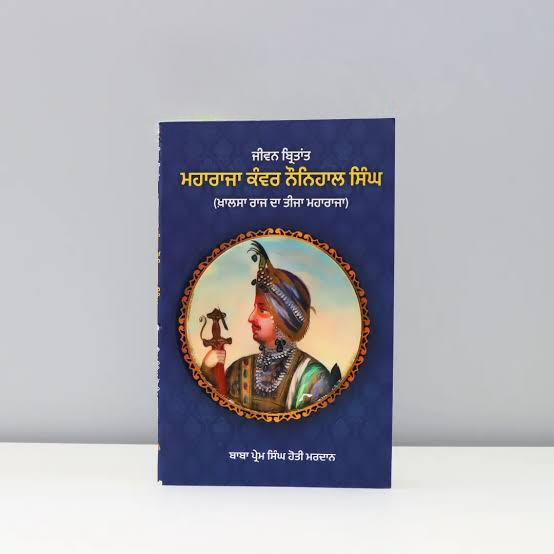
Kunwar Naunihaal Singh (ਕੁੰਵਰ ਨੌਨਿਹਾਲ ਸਿੰਘ) Book – Baba Prem Singh Hoti Mardan
Kunwar Naunihaal Singh (ਕੁੰਵਰ ਨੌਨਿਹਾਲ ਸਿੰਘ) Book – Baba Prem Singh Hoti Mardan
Couldn't load pickup availability
Share
Kunwar Naunihaal Singh is a historical biography written by Baba Prem Singh Hoti Mardan, one of the respected Sikh historians and scholars of Punjabi literature. The book explores the life of Kanwar Nau Nihal Singh, the grandson of Maharaja Ranjit Singh and son of Maharaja Kharak Singh, who became an important figure in the history of the Sikh Empire.
Although his life was short, Nau Nihal Singh is remembered for his courage, intelligence, administrative abilities and potential as a successor to the throne of the Sikh Empire. His life unfolded during a critical period when the Lahore Darbar was experiencing political rivalries, internal conflicts and struggles for power following the death of Maharaja Ranjit Singh.
ਕੁੰਵਰ ਨੌਨਿਹਾਲ ਸਿੰਘ ਪ੍ਰਸਿੱਧ ਸਿੱਖ ਇਤਿਹਾਸਕਾਰ ਬਾਬਾ ਪ੍ਰੇਮ ਸਿੰਘ ਹੋਤੀ ਮਰਦਾਨ ਦੀ ਲਿਖੀ ਹੋਈ ਇੱਕ ਇਤਿਹਾਸਕ ਜੀਵਨੀ ਹੈ। ਇਸ ਪੁਸਤਕ ਵਿੱਚ ਮਹਾਰਾਜਾ ਰਣਜੀਤ ਸਿੰਘ ਦੇ ਪੋਤਰੇ ਅਤੇ ਮਹਾਰਾਜਾ ਖੜਕ ਸਿੰਘ ਦੇ ਪੁੱਤਰ ਕੁੰਵਰ ਨੌਨਿਹਾਲ ਸਿੰਘ ਦੇ ਜੀਵਨ, ਸ਼ਖ਼ਸੀਅਤ, ਰਾਜਨੀਤਿਕ ਸੂਝ-ਬੂਝ ਅਤੇ ਸਿੱਖ ਰਾਜ ਵਿੱਚ ਉਨ੍ਹਾਂ ਦੀ ਭੂਮਿਕਾ ਬਾਰੇ ਜਾਣਕਾਰੀ ਦਿੱਤੀ ਗਈ ਹੈ।
ਕੁੰਵਰ ਨੌਨਿਹਾਲ ਸਿੰਘ ਦਾ ਜੀਵਨ ਭਾਵੇਂ ਛੋਟਾ ਰਿਹਾ, ਪਰ ਉਹ ਆਪਣੀ ਬਹਾਦਰੀ, ਸੂਝਵਾਨ ਸੁਭਾਅ ਅਤੇ ਪ੍ਰਸ਼ਾਸਨਿਕ ਯੋਗਤਾ ਕਰਕੇ ਸਿੱਖ ਇਤਿਹਾਸ ਵਿੱਚ ਇੱਕ ਮਹੱਤਵਪੂਰਨ ਸਥਾਨ ਰੱਖਦੇ ਹਨ। ਮਹਾਰਾਜਾ ਰਣਜੀਤ ਸਿੰਘ ਦੇ ਅਕਾਲ ਚਲਾਣੇ ਤੋਂ ਬਾਅਦ ਲਾਹੌਰ ਦਰਬਾਰ ਵਿੱਚ ਪੈਦਾ ਹੋਈ ਰਾਜਨੀਤਿਕ ਖਿੱਚੋਤਾਣ ਅਤੇ ਸੱਤਾ ਸੰਘਰਸ਼ ਦੇ ਦੌਰ ਵਿੱਚ ਉਨ੍ਹਾਂ ਦੀ ਭੂਮਿਕਾ ਬਹੁਤ ਅਹਿਮ ਸੀ।
Book Details
-
Book Name: Kunwar Naunihaal Singh
-
Punjabi Title: ਕੁੰਵਰ ਨੌਨਿਹਾਲ ਸਿੰਘ
-
Author: Baba Prem Singh Hoti Mardan (ਬਾਬਾ ਪ੍ਰੇਮ ਸਿੰਘ ਹੋਤੀ ਮਰਦਾਨ)
-
Category: Sikh History | Punjab History | Historical Biography
-
Language: Punjabi (Gurmukhi)
-
Original Publication: 1927
-
Subject: Life and history of Kanwar Nau Nihal Singh
-
Available at: Kalam Kitaab – Punjabi Book Store
Kunwar Naunihaal Singh — Detailed Guide
Baba Prem Singh Hoti Mardan: The Historian Behind the Book
Baba Prem Singh Hoti Mardan holds an important place among the historians and literary scholars who worked to preserve Sikh history. He devoted much of his life to researching Sikh personalities, historical events, the Sikh Empire and the development of Sikh political authority in Punjab.
Born on 2 November 1882 at Hoti Mardan, in the Peshawar region, Baba Prem Singh Hoti Mardan was educated in several languages, including Punjabi, Persian, Urdu and English. His linguistic knowledge helped him access historical material from different sources.
He was particularly interested in the history of the Sikh rulers, military leaders and personalities who contributed to the establishment and development of the Sikh Empire.
Among his important historical works are biographies of Maharaja Ranjit Singh, Baba Phula Singh Akali, Hari Singh Nalwa, Maharaja Sher Singh, Nawab Kapur Singh and Kanwar Nau Nihal Singh.
His biography of Kanwar Nau Nihal Singh was published in 1927. It reflects his interest in documenting the lives of important historical personalities through written records and historical accounts.
Baba Prem Singh Hoti Mardan's contribution remains valuable for readers who want to explore Sikh history through early Punjabi historical writing.
Who Was Kanwar Nau Nihal Singh?
Kanwar Nau Nihal Singh was the grandson of Maharaja Ranjit Singh and the son of Maharaja Kharak Singh and Maharani Chand Kaur. He was born in 1821 and belonged to the royal family of the Sikh Empire.
He grew up during a period when the Sikh kingdom was one of the most powerful political forces in northern India. His grandfather, Maharaja Ranjit Singh, had established a strong kingdom through military campaigns, diplomacy and the consolidation of different territories.
Nau Nihal Singh was considered an important successor within the royal family. He received an upbringing appropriate to his position and became involved in military and political affairs at a young age.
Historical accounts describe him as an intelligent and capable young prince who demonstrated an interest in administration and military matters.
His life, however, coincided with a period of increasing political uncertainty. The death of Maharaja Ranjit Singh in 1839 created a difficult situation for the Lahore Darbar, and the future of the Sikh Empire became increasingly uncertain.
Nau Nihal Singh's role in these developments makes his biography an important part of the history of the Sikh kingdom.
Maharaja Ranjit Singh and the Sikh Empire
To understand the importance of Nau Nihal Singh, it is necessary to understand the political legacy of Maharaja Ranjit Singh.
Maharaja Ranjit Singh established the Sikh Empire and brought large territories of Punjab and surrounding regions under his authority. His kingdom became known for its military strength, administrative organisation and diplomatic relationships with neighbouring powers.
His government included people from different religious and social backgrounds. The Lahore Darbar became an important centre of political and administrative activity.
The empire maintained its independence despite the growing presence of British power in northern India.
However, the stability of the kingdom depended considerably on the authority and leadership of Maharaja Ranjit Singh. His death in 1839 created a succession problem and exposed rivalries within the royal family and the Lahore Darbar.
The position of Nau Nihal Singh became particularly important in this changing political environment because he was viewed as a potential future ruler.
Maharaja Kharak Singh and the Question of Succession
After Maharaja Ranjit Singh's death, his son Kharak Singh succeeded him as Maharaja.
However, his reign was marked by political difficulties and disagreements within the Lahore Darbar. Several powerful nobles and courtiers competed for influence, while questions concerning the administration and future direction of the kingdom became increasingly complicated.
Nau Nihal Singh gradually became an important figure in the political affairs of the kingdom. His growing involvement in administration and state matters created expectations about his future role.
The relationship between father and son and the question of who exercised real authority within the Lahore Darbar became part of the larger political struggle.
This period is important because it demonstrates how the succession arrangements of the Sikh Empire became increasingly unstable after the death of its founder.
Nau Nihal Singh's Political and Administrative Abilities
Nau Nihal Singh is remembered in historical accounts as a young prince with considerable potential.
He was associated with military and administrative responsibilities and was considered capable of handling matters of the state.
His personality and approach to governance attracted attention among sections of the Lahore Darbar. At a time when political factions were competing for influence, his position was particularly significant.
The kingdom required strong leadership to maintain the political structure established by Maharaja Ranjit Singh. The young prince was viewed by some as a possible leader who could preserve the strength and independence of the Sikh Empire.
His early death prevented him from developing this potential over a longer period.
Baba Prem Singh Hoti Mardan's biography explores his life and the historical circumstances that shaped his political position.
The Lahore Darbar After Maharaja Ranjit Singh
The Lahore Darbar was the centre of political authority in the Sikh Empire. It included members of the royal family, military commanders, ministers, nobles and influential courtiers.
During Maharaja Ranjit Singh's reign, his personal authority helped maintain a balance between these different groups.
After his death, the situation changed considerably. Rivalries and political competition became more visible, and different factions attempted to influence the succession and administration.
The royal family itself experienced tensions, while powerful nobles sought to strengthen their positions.
These internal conflicts weakened the political stability of the empire and made it increasingly difficult to maintain the unity that had existed under Maharaja Ranjit Singh.
Nau Nihal Singh became an important personality within this complicated political environment.
The Role of the Dogra Sardars
The Dogra family held considerable influence in the Lahore Darbar during the later years of Maharaja Ranjit Singh's reign and after his death.
Prominent Dogra personalities, including Gulab Singh, Dhian Singh and Suchet Singh, occupied important positions within the political and administrative structure of the kingdom.
Their influence became particularly significant during the succession struggles that followed Maharaja Ranjit Singh's death.
The Dogra Sardars were involved in the complex political relationships between different members of the royal family and the Lahore Darbar.
The changing balance of power among the royal household, Dogra nobles and other court factions contributed to the instability of the Sikh Empire.
Understanding their role is essential for studying the political circumstances surrounding Nau Nihal Singh.
The book explores this environment and the political developments that influenced the future of the kingdom.
Nau Nihal Singh and the Future of the Sikh Empire
Nau Nihal Singh is often remembered as one of the most promising members of Maharaja Ranjit Singh's family.
His youth, political involvement and military reputation led to expectations about the future of the Sikh Empire.
The kingdom was facing several challenges, including internal factionalism and increasing pressure from the British East India Company.
A capable ruler was needed to maintain the administration, manage the powerful nobles and protect the kingdom's independence.
Nau Nihal Singh's position made him an important figure in these circumstances.
His sudden death in 1840 changed the course of the succession struggle and added another layer of uncertainty to the political situation at Lahore.
The question of what the Sikh Empire might have experienced under a longer reign by Nau Nihal Singh remains a subject of historical reflection, although such possibilities cannot be established with certainty.
The Mysterious Death of Kanwar Nau Nihal Singh
One of the most discussed episodes in the life of Nau Nihal Singh is his sudden death in November 1840.
His father, Maharaja Kharak Singh, died in November 1840. After attending his father's cremation, Nau Nihal Singh was returning towards Lahore when a section of a structure near the Hazuri Bagh gateway collapsed.
He was severely injured in the incident and died shortly afterwards.
The circumstances surrounding his death have attracted considerable historical debate. Questions have been raised about whether the collapse was accidental or whether political conspiracy played a role.
The incident occurred at a time when the Lahore Darbar was experiencing intense political rivalry and competing interests.
It is important to distinguish between the recorded event and later interpretations about its cause. While the structural collapse and Nau Nihal Singh's death are part of the historical record, claims of deliberate assassination remain matters of historical debate.
Baba Prem Singh Hoti Mardan's biography examines this significant episode within the wider political circumstances of the time.
The Political Consequences of His Death
The death of Nau Nihal Singh created another major succession crisis for the Sikh Empire.
He had been regarded as an important potential successor, and his absence further complicated the political situation at Lahore.
The royal family and different court factions became involved in continuing struggles for authority.
Maharani Chand Kaur, the widow of Maharaja Kharak Singh and mother of Nau Nihal Singh, also became involved in the succession dispute. Sher Singh, another son of Maharaja Ranjit Singh, later emerged as a claimant to the throne.
These events reflected the growing instability within the Sikh Empire.
The political struggles that followed weakened the unity of the Lahore Darbar and contributed to the circumstances that eventually led to the Anglo-Sikh Wars and the British annexation of Punjab in 1849.
The Importance of Nau Nihal Singh in Sikh History
Nau Nihal Singh occupies an important place in the history of the Sikh Empire because his life was closely connected with one of the most critical periods of political transition.
He belonged to the generation that inherited the kingdom established by Maharaja Ranjit Singh. His position within the royal family placed him at the centre of questions concerning succession, administration and the future of the empire.
His death in 1840 was not merely the loss of a royal personality. It was also a significant event in the continuing political uncertainty of the Lahore Darbar.
Studying his life helps readers understand the importance of leadership, succession arrangements and political unity in maintaining a kingdom.
It also provides a wider perspective on the events that followed Maharaja Ranjit Singh's death.
Historical Sources Behind the Biography
One of the important aspects of Baba Prem Singh Hoti Mardan's historical writing was his interest in consulting different sources.
Accounts of Nau Nihal Singh's life have been drawn from historical writings, including English and Persian material and contemporary accounts.
The biography is associated with the author's efforts to use rare historical books and written testimonies to document the life of the young prince.
This approach makes the book valuable for readers interested in early Punjabi historical scholarship.
At the same time, historical writing from different periods can contain varying interpretations of events. Readers studying the political circumstances of the Lahore Darbar may benefit from comparing this biography with other historical works and contemporary records.
Why Read Kunwer Naunihaal Singh?
Kunwer Naunihaal Singh is worth reading for anyone who wants to explore the history of the Sikh Empire beyond the reign of Maharaja Ranjit Singh.
Maharaja Ranjit Singh's achievements are widely discussed, but the events that followed his death are equally important for understanding the decline of the Sikh kingdom.
This book brings attention to a young royal personality whose life was closely connected with the political future of Punjab.
It also introduces readers to the complex world of the Lahore Darbar, the role of influential nobles, succession disputes and the circumstances that contributed to the weakening of the Sikh Empire.
Through Baba Prem Singh Hoti Mardan's historical account, readers can explore an important personality and a significant period in Sikh history.
Who Should Read This Book?
Kunwer Naunihaal Singh may appeal to:
- Readers interested in Sikh history and the Sikh Empire.
- Admirers of Maharaja Ranjit Singh and his royal family.
- Readers studying the history of the Lahore Darbar.
- People interested in the life of Maharaja Kharak Singh and Kanwar Nau Nihal Singh.
- Readers exploring the political history of nineteenth-century Punjab.
- Students of Sikh history and historical biography.
- Readers interested in the Dogra Sardars and their role in the Lahore Darbar.
- People studying the decline of the Sikh Empire and the Anglo-Sikh Wars.
- Collectors of historical Punjabi books and works by Baba Prem Singh Hoti Mardan.
Baba Prem Singh Hoti Mardan's Contribution to Sikh Historical Literature
Baba Prem Singh Hoti Mardan devoted much of his literary life to recording the biographies of important Sikh personalities.
His works include accounts of military leaders, rulers and political figures who shaped the history of the Sikh community.
Some of his notable writings include:
- Jeevan Britant Baba Phula Singh Akali
- Jeevan Charitar Maharaja Ranjit Singh
- Jeevan Britant Kanwar Naunihal Singh
- Jeevan Britant Hari Singh Nalwa
- Khalsa Raj De Usariye
- Jeevan Britant Maharaja Sher Singh
- Jeevan Britant Nawab Kapur Singh
These works reflect his sustained interest in preserving the history of the Sikh Empire and the personalities associated with it.
His biography of Nau Nihal Singh is an important part of this wider historical contribution.
A Window into the History of the Sikh Empire
The story of Kanwar Nau Nihal Singh is closely connected with the transformation of the Sikh Empire after Maharaja Ranjit Singh.
His life reflects a period of great political importance, when the Lahore Darbar faced internal rivalries, succession disputes and growing challenges to its authority.
Although Nau Nihal Singh's life ended at a young age, his place in the history of the Sikh kingdom remains significant.
Kunwer Naunihaal Singh by Baba Prem Singh Hoti Mardan gives readers an opportunity to explore his life, political role and the historical circumstances surrounding his death.
For readers interested in Sikh history, the Lahore Darbar and the legacy of Maharaja Ranjit Singh, this biography is a meaningful addition to a Punjabi historical literature collection.
Explore Kunwer Naunihaal Singh at Kalam Kitaab and discover the history of an important personality from the era of the Sikh Empire.