


Kalam Kitaab
Birha Tu Sultan (ਬਿਰਹਾ ਤੂੰ ਸੁਲਤਾਨ) – Shiv Kumar Batalvi
Birha Tu Sultan (ਬਿਰਹਾ ਤੂੰ ਸੁਲਤਾਨ) – Shiv Kumar Batalvi
Couldn't load pickup availability
Share
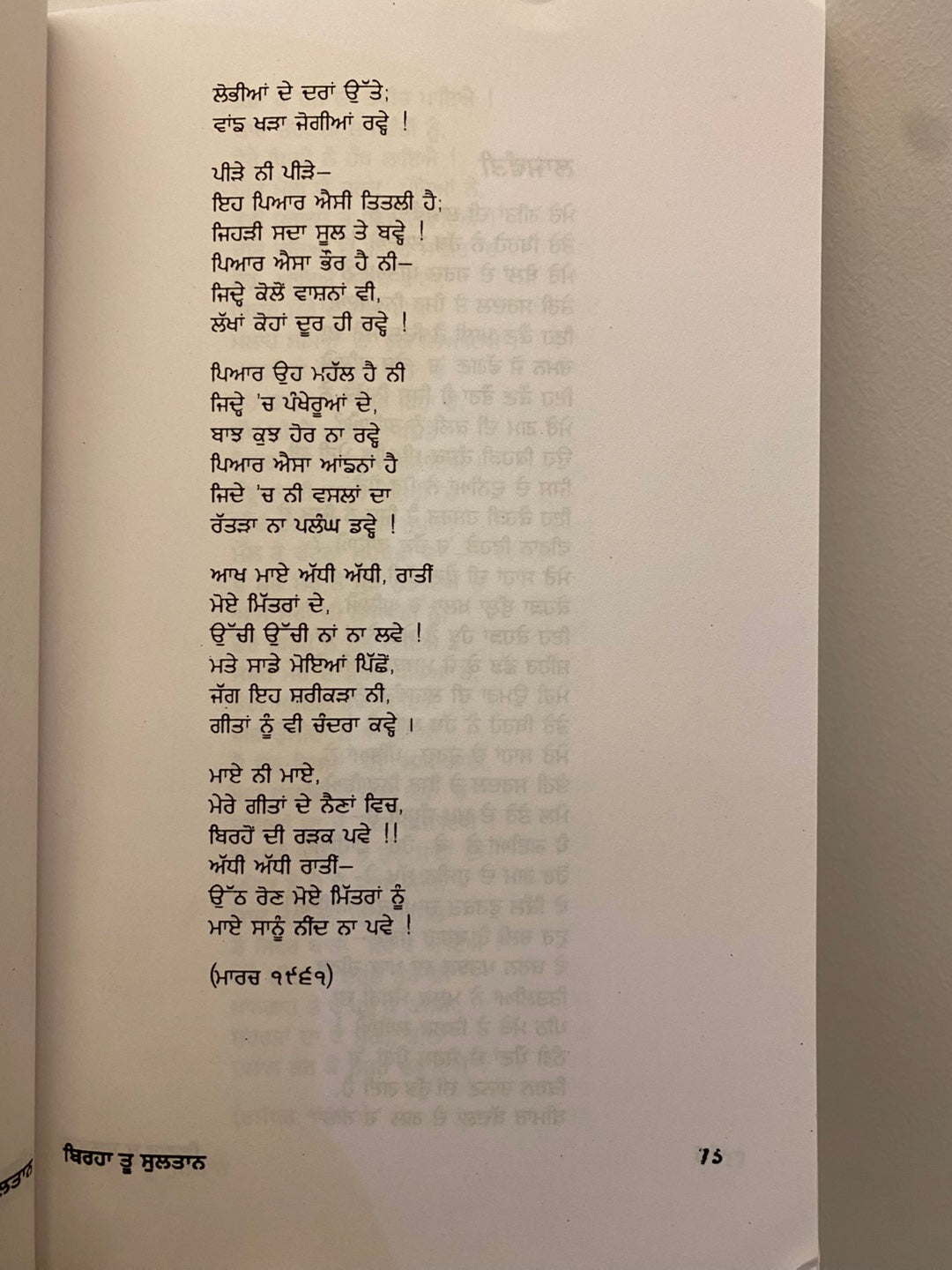
"Birha Tu Sultan" is a poignant poetry collection by Shiv Kumar Batalvi, often regarded as the "King of Separation" in Punjabi literature. It features his iconic title poem celebrating birha (longing and separation) as the supreme emotion, alongside other heartfelt verses exploring love, pain, and human existence.
"ਬਿਰਹਾ ਤੂੰ ਸੁਲਤਾਨ" ਸ਼ਿਵ ਕੁਮਾਰ ਬਟਾਲਵੀ ਦਾ ਇੱਕ ਮਾਰਮਿਕ ਕਾਵਿ-ਸੰਗ੍ਰਹਿ ਹੈ, ਜੋ ਪੰਜਾਬੀ ਸਾਹਿਤ ਵਿੱਚ "ਬਿਰਹਾ ਦੇ ਸੁਲਤਾਨ" ਵਜੋਂ ਜਾਣੇ ਜਾਂਦੇ ਹਨ। ਇਸ ਵਿੱਚ ਸਿਰਲੇਖੀ ਕਵਿਤਾ ਬਿਰਹੇ ਨੂੰ ਸਰਵਉੱਚ ਭਾਵਨਾ ਵਜੋਂ ਮਨਾਉਂਦੀ ਹੈ, ਨਾਲ ਹੀ ਪਿਆਰ, ਦਰਦ ਅਤੇ ਮਨੁੱਖੀ ਹੋਂਦ ਨੂੰ ਛੂਹਣ ਵਾਲੀਆਂ ਹੋਰ ਰਚਨਾਵਾਂ ਸ਼ਾਮਲ ਹਨ।
Book Title: Birha Tu Sultan (ਬਿਰਹਾ ਤੂੰ ਸੁਲਤਾਨ)
Author: Shiv Kumar Batalvi
Language: Punjabi (Gurmukhi)
Genre: Poetry Collection (ਕਾਵਿ-ਸੰਗ੍ਰਹਿ)
Available at: Kalam Kitaab


Birha Tu Sultan by Shiv Kumar Batalvi | The Greatest Punjabi Poetry Collection on Love, Separation and Longing
Among all Shiv Kumar Batalvi Books, Birha Tu Sultan (ਬਿਰਹਾ ਤੂੰ ਸੁਲਤਾਨ) holds a place that very few poetry collections in Punjabi literature have ever achieved. It is not merely a collection of poems—it is an emotional journey into the deepest corners of the human heart. Through themes of love, separation (birha), longing, pain, youth, beauty, mortality, and the search for meaning, Shiv Kumar Batalvi created a work that continues to touch readers more than five decades after its publication.
For countless lovers of Punjabi Books and Punjabi Poetry Books, Birha Tu Sultan is considered the pinnacle of modern Punjabi poetry. Every poem reflects Shiv Kumar Batalvi's extraordinary ability to transform personal emotions into universal experiences. Whether one has experienced love, heartbreak, loss, or simply the longing for something beyond reach, the poems in this collection feel deeply personal.
Unlike poetry that relies on complex philosophical language or difficult literary symbolism, Shiv Kumar Batalvi writes with remarkable simplicity. His words are easy to understand, yet they carry immense emotional depth. A single verse often expresses emotions that many people struggle to describe in everyday life.
It is this combination of simplicity and emotional intensity that has made Birha Tu Sultan one of the most beloved Punjabi Poetry Books ever written.
Why Birha Tu Sultan Is Shiv Kumar Batalvi's Masterpiece
Every great poet has one work that defines their literary legacy.
For Shiv Kumar Batalvi, that work is undoubtedly Birha Tu Sultan.
Although he wrote several celebrated collections, this book occupies a unique place because it brings together the themes that made him one of Punjab's greatest poets. Love, separation, beauty, youth, loneliness, death, memory, and longing all flow naturally through its pages.
Readers often describe this collection as emotionally overwhelming because it speaks directly to experiences that almost everyone encounters at some point in life.
Unlike many poets who merely describe emotions, Shiv Kumar Batalvi makes readers feel them.
His poems do not remain on the page—they stay in the reader's heart.
This emotional honesty explains why Birha Tu Sultan continues to inspire readers of every generation.
More Than a Collection of Poems
Many poetry collections consist of unrelated poems gathered into one volume.
Birha Tu Sultan feels different.
Although each poem can be appreciated individually, together they create an emotional landscape that explores the many forms of longing.
The poems move naturally between hope and despair, love and loneliness, memory and reality, youth and mortality.
Readers gradually realise that the book is not simply about romantic love.
It is about every form of separation that human beings experience throughout life.
A Landmark in Punjabi Poetry
Modern Punjabi poetry underwent significant transformation during the twentieth century, and Shiv Kumar Batalvi played a central role in that evolution.
While earlier Punjabi poetry often focused on spirituality, folklore, heroic traditions, or social reform, Shiv Kumar brought intensely personal emotions to the centre of his work.
He demonstrated that the deepest human feelings could become powerful literary subjects.
This shift influenced countless Punjabi poets who followed him.
Today, Birha Tu Sultan remains essential reading for anyone seeking to understand the development of modern Punjabi literature.
Understanding the Meaning of "Birha Tu Sultan"
Before reading the poems, it is important to understand the meaning behind the title itself.
The phrase "ਬਿਰਹਾ ਤੂੰ ਸੁਲਤਾਨ" can be understood as "O Separation, You Are the King" or "Separation, You Rule Above All."
This title captures the central philosophy of the entire collection.
Rather than treating separation as a temporary sadness, Shiv Kumar Batalvi presents it as one of the greatest forces shaping human life.
What Does "Birha" Mean?
The Punjabi word ਬਿਰਹਾ (Birha) carries a meaning far richer than the English word "separation."
In Punjabi literature, birha refers to the deep emotional pain experienced when someone or something precious is absent.
That absence may involve:
A lover separated from the beloved.
A child separated from parents.
A devotee longing for the Divine.
A person remembering childhood.
Someone grieving the death of a loved one.
An individual searching for purpose or inner peace.
Because of this broad meaning, birha becomes a universal human experience.
Every reader understands separation differently, making the poems deeply personal.
Why Does Shiv Kumar Call Birha a Sultan?
The word Sultan represents supreme authority.
By calling separation a king, Shiv Kumar suggests that no human emotion possesses greater power.
Love may begin relationships.
Hope may inspire dreams.
Happiness may brighten life.
But separation changes people forever.
It teaches patience.
It deepens compassion.
It transforms memory.
It gives meaning to love itself.
Without separation, love would never reveal its true depth.
This philosophical idea appears repeatedly throughout the collection.
Shiv Kumar Batalvi: The Poet Behind the Pain
Understanding Birha Tu Sultan also requires understanding the man who wrote it.
Shiv Kumar Batalvi was not merely writing poetry from imagination.
Much of his work reflects genuine emotional experiences.
His poetry often explores themes of incomplete love, youthful longing, loneliness, beauty, mortality, and the awareness that life itself is temporary.
Because these emotions emerged from sincere personal reflection, readers feel an extraordinary authenticity in his writing.
Unlike poets who observe emotions from a distance, Shiv Kumar appears to live inside every poem he writes.
This emotional sincerity is one of the defining characteristics of Shiv Kumar Batalvi Books.
The Poet of Love and Sorrow
Shiv Kumar Batalvi is often called the "Poet of Birha."
This title does not mean he wrote only about sadness.
Instead, it reflects his remarkable ability to transform sorrow into artistic beauty.
His poems remind readers that suffering is not merely something to endure.
It can also deepen understanding, compassion, creativity, and spiritual awareness.
This perspective distinguishes his poetry from ordinary expressions of grief.
His sadness never becomes hopeless.
Instead, it becomes meaningful.
Simple Language, Extraordinary Emotion
One reason readers continue to recommend Birha Tu Sultan is the accessibility of Shiv Kumar's language.
He does not depend upon difficult literary vocabulary.
His poems use familiar Punjabi words, natural rhythms, and vivid imagery.
Yet beneath this simplicity lies remarkable emotional complexity.
A single line often captures feelings that readers have carried within themselves for years.
This ability to express profound emotions through simple language explains why his poetry continues to resonate with readers from every background.
The Emotional World of Birha Tu Sultan
One of the greatest strengths of this collection is its emotional range.
Although separation forms the central theme, the poems explore many different dimensions of human experience.
Love That Cannot Be Possessed
Throughout the collection, love is presented not as ownership but as longing.
The beloved often remains distant.
Sometimes physically absent.
Sometimes emotionally unreachable.
Sometimes remembered only through memory.
This distance creates the emotional intensity that defines Shiv Kumar's poetry.
Rather than asking whether love succeeds or fails, he explores how love transforms the person who experiences it.
Longing as a Way of Life
For Shiv Kumar Batalvi, longing is not merely a temporary feeling.
It becomes a permanent companion.
The poems suggest that human beings spend much of their lives searching—for love, belonging, understanding, beauty, peace, or God.
Because complete fulfilment remains rare, longing becomes an essential part of existence.
Readers often recognise their own lives within this philosophy.
Beauty and Impermanence
Flowers bloom.
Youth fades.
Seasons change.
Relationships evolve.
Life itself remains temporary.
Throughout Birha Tu Sultan, Shiv Kumar repeatedly reminds readers that beauty becomes precious precisely because it cannot last forever.
Rather than creating despair, this awareness encourages deeper appreciation for every meaningful moment.
The Opening Poems and Their Emotional Atmosphere
From the very first poems, readers enter a world filled with sensitivity and emotional honesty.
Instead of dramatic narratives, Shiv Kumar begins by establishing an atmosphere of reflection.
His poetry does not ask readers to hurry.
It invites them to slow down, listen carefully, and experience each emotion fully.
His opening verses immediately reveal several qualities that continue throughout the collection:
Deep emotional sincerity.
Musical rhythm inspired by Punjabi folk traditions.
Rich natural imagery.
Universal themes expressed through personal experiences.
Simplicity that conceals remarkable literary depth.
One of the collection's most memorable lines is:
"ਬਿਰਹਾ ਤੂੰ ਸੁਲਤਾਨ..."
In just a few words, Shiv Kumar establishes the emotional philosophy that shapes the entire book: separation is not merely an emotion but the greatest ruler of the human heart.
Why Every Lover of Punjabi Poetry Should Read Birha Tu Sultan
There are many excellent Punjabi Poetry Books, but very few possess the emotional depth and literary beauty of Birha Tu Sultan.
This collection is ideal for readers who wish to experience poetry that speaks directly to the heart rather than merely displaying technical skill.
It is equally valuable for young readers discovering Punjabi poetry for the first time and experienced readers returning to a timeless classic.
Every reading reveals something new.
At one stage of life, a poem may express youthful love.
Years later, the same poem may speak about memory, loss, or spiritual longing.
This ability to grow alongside the reader is the mark of truly great literature.
Major Themes in Birha Tu Sultan
One of the reasons Birha Tu Sultan continues to be regarded as one of the greatest Punjabi Poetry Books is the richness of its themes. Although every poem has its own voice and emotional atmosphere, they are united by a common philosophy—that human life is incomplete without longing. Shiv Kumar Batalvi believed that joy and sorrow, love and separation, hope and despair all exist together, and it is this balance that gives life its deepest meaning.
Unlike many poetry collections that revolve around a single subject, Birha Tu Sultan explores numerous dimensions of human experience. Every poem offers a different perspective, allowing readers to see separation not merely as pain but as a force that shapes personality, creativity, and spiritual awareness.
Love in Birha Tu Sultan
Love Beyond Romance
When readers first hear about Birha Tu Sultan, they often assume it is simply a collection of romantic poems. While romantic love is certainly an important theme, Shiv Kumar Batalvi's understanding of love is much broader.
For him, love is not limited to two people. It is an emotion that connects human beings with family, nature, memories, childhood, homeland, and even God. His poems explore every form of attachment that gives life meaning.
This universal understanding of love allows readers from different backgrounds to relate to his poetry. Whether someone has experienced the joy of romance, the pain of losing a loved one, or the longing for a place left behind, the emotions remain familiar.
Love That Cannot Always Be Fulfilled
One of the defining characteristics of Shiv Kumar Batalvi's poetry is that love rarely reaches a perfect conclusion.
Instead of celebrating happy endings, he explores what happens when love remains incomplete.
Unfulfilled love becomes memory.
Memory becomes longing.
Longing becomes poetry.
This emotional transformation appears throughout Birha Tu Sultan, making the collection deeply reflective rather than sentimental.
Readers soon realise that the poems are not asking whether love succeeds or fails. They ask how love changes the person who experiences it.
The Philosophy of Separation (Birha)
Separation as a Teacher
Most people think of separation as something negative.
Shiv Kumar Batalvi presents a completely different perspective.
Throughout Birha Tu Sultan, separation becomes a teacher. It forces individuals to understand themselves more deeply. It teaches patience, compassion, gratitude, and emotional maturity.
According to the poet, many people only recognise the true value of love after experiencing absence.
The pain of losing something meaningful often reveals its importance more clearly than its presence ever could.
This philosophical depth is one of the reasons the collection continues to inspire readers decades after it was written.
Separation Gives Birth to Creativity
Many great works of art emerge from emotional experiences.
Shiv Kumar Batalvi repeatedly suggests that longing awakens creativity.
When the heart feels incomplete, it begins searching for expression through music, poetry, painting, or prayer.
For the poet, separation is not merely suffering.
It becomes the source of beauty itself.
This explains why his poems never feel hopeless, even when they describe profound sadness.
Nature as a Living Character
One of the most beautiful features of Birha Tu Sultan is Shiv Kumar Batalvi's relationship with nature.
Nature is not simply decoration within his poetry.
It becomes another character.
Trees, flowers, rivers, rain, seasons, birds, moonlight, and changing skies all participate in the emotional lives of the poems.
The Changing Seasons
Throughout the collection, seasons often reflect human emotions.
Spring suggests hope, youth, and new beginnings.
Autumn represents loss and fading beauty.
Rain becomes a symbol of memory and longing.
Winter reflects loneliness and silence.
Instead of describing emotions directly, Shiv Kumar frequently allows the natural world to express what his characters cannot put into words.
This technique creates poetry that feels both visual and deeply emotional.
Flowers and Beauty
Flowers appear repeatedly throughout the collection.
They represent youth, innocence, beauty, and the temporary nature of life.
A flower blooms for only a short time before fading.
Similarly, youth passes.
Love changes.
People grow older.
Memories remain.
Through these natural symbols, Shiv Kumar reminds readers that beauty is precious precisely because it is temporary.
Death and Impermanence
Another recurring theme throughout Birha Tu Sultan is the awareness that life is fragile.
Unlike writers who treat death as something frightening, Shiv Kumar Batalvi often presents mortality as a natural part of existence.
His poems encourage readers to appreciate every meaningful relationship because nothing lasts forever.
Youth Is Temporary
Shiv Kumar was still a young man when he wrote many of his greatest poems, yet he possessed an extraordinary awareness of mortality.
Again and again, he reminds readers that youth disappears quickly.
Beauty fades.
Time never stops.
Because life is short, every moment of genuine love becomes infinitely valuable.
This awareness gives his poetry both urgency and tenderness.
Memory Lives Forever
Although people leave us, memories remain.
Throughout Birha Tu Sultan, memory becomes almost as important as the present.
Past experiences continue shaping emotions long after they have ended.
Readers often discover that Shiv Kumar's poems are less about remembering specific people than about understanding how memory itself transforms us.
The Influence of Punjabi Folk Tradition
Inspired by Punjab's Musical Heritage
One reason Shiv Kumar Batalvi's poetry remains so popular is its close relationship with Punjabi folk culture.
His verses often possess a musical quality that allows them to be sung naturally.
Many of his poems have later been performed by celebrated Punjabi singers because they already contain the rhythm and emotional flow of traditional Punjabi music.
This connection between poetry and music makes Birha Tu Sultan especially enjoyable to read aloud.
The Language of Ordinary People
Although Shiv Kumar was an exceptionally gifted literary poet, he never distanced himself from ordinary Punjabi speech.
He chose words that readers could immediately understand.
This accessibility explains why his poetry appeals equally to literary scholars and everyday readers.
Simple language does not reduce the depth of his poetry.
Instead, it allows emotional truth to remain at the centre of every poem.
Shiv Kumar Batalvi's Writing Style in Birha Tu Sultan
The lasting popularity of Shiv Kumar Batalvi Books is closely connected to his distinctive literary style.
Few Punjabi poets have combined emotional intensity with such graceful simplicity.
Simple Words, Deep Meaning
Perhaps the first thing readers notice is the clarity of his language.
He rarely relies on difficult vocabulary or complicated literary structures.
Instead, he allows ordinary Punjabi words to communicate extraordinary emotions.
This simplicity creates poetry that welcomes every reader while rewarding repeated reading with new layers of meaning.
Musical Rhythm
Even when read silently, Shiv Kumar's poems possess a natural musical flow.
The rhythm reflects the influence of Punjabi folk songs and oral storytelling traditions.
This musical quality explains why many readers instinctively begin reading his poetry aloud.
The sound of the words becomes as important as their meaning.
Emotional Honesty
Shiv Kumar never hides behind literary technique.
He writes openly about vulnerability, loneliness, hope, and heartbreak.
Readers trust his voice because his emotions feel sincere.
Nothing appears artificial.
Nothing feels exaggerated.
Instead, every poem carries the quiet confidence of lived experience.
Powerful Imagery
One of the hallmarks of Birha Tu Sultan is its vivid imagery.
Instead of explaining emotions abstractly, Shiv Kumar paints pictures.
A fading flower.
An empty road.
The evening sky.
Rain falling over fields.
A lonely bird.
These images remain in the reader's memory long after the poem has ended.
Why Readers Connect So Deeply with Birha Tu Sultan
Many books become popular during one generation before gradually disappearing.
Birha Tu Sultan has followed a very different path.
Its readership continues to grow because every generation discovers new meanings within its pages.
Young readers often relate to the poems through love and longing.
Older readers recognise deeper themes of memory, time, family, loss, and acceptance.
This ability to evolve alongside the reader is one of the defining characteristics of timeless literature.
The poems never force a single interpretation.
Instead, they invite readers to bring their own experiences into the reading process.
As a result, no two people read Birha Tu Sultan in exactly the same way.
Why This Collection Continues to Inspire Modern Readers
Even though Birha Tu Sultan was written decades ago, its themes remain surprisingly contemporary.
Modern readers continue to struggle with loneliness, emotional distance, changing relationships, migration, loss, and the search for belonging.
Technology has changed how people communicate, but it has not changed the emotions that define human life.
Shiv Kumar Batalvi understood these emotions with extraordinary sensitivity.
His poetry reminds readers that sadness is not weakness, longing is not failure, and love continues to shape us even when it cannot remain with us.
This timeless understanding of the human heart explains why Birha Tu Sultan continues to be regarded as one of the greatest achievements in Punjabi poetry and one of the essential Punjabi Books for anyone who wishes to experience the emotional beauty of Punjabi literature.
The Literary Importance of Birha Tu Sultan
Very few poetry collections achieve the status of becoming timeless classics. Many books are admired during their own era but slowly fade from public memory as literary tastes change. Birha Tu Sultan has followed a completely different path. More than five decades after its publication, it remains one of the most widely read and respected Punjabi Poetry Books ever written.
Its importance lies not only in its beautiful language but also in the emotional truth that fills every page. Shiv Kumar Batalvi demonstrated that poetry could be deeply personal while still speaking to millions of readers. His poems are rooted in his own experiences, yet they never become limited to autobiography. Instead, they become mirrors in which readers discover their own emotions.
Today, Birha Tu Sultan is read by students, literary scholars, poets, musicians, and ordinary readers who simply wish to experience the beauty of Punjabi literature. It has become an essential part of Punjab's literary heritage and continues to influence new generations of writers.
How Birha Tu Sultan Changed Punjabi Poetry
Bringing Personal Emotions to the Centre
Punjabi literature has always been rich with poetry. From the spiritual verses of Guru Nanak Dev Ji to the Sufi poetry of Bulleh Shah and Shah Hussain, and the romantic epics of Waris Shah, Punjabi poetry has celebrated spirituality, devotion, heroism, and folklore.
Shiv Kumar Batalvi inherited this rich tradition but gave it a new direction.
Rather than focusing primarily on historical heroes or legendary lovers, he explored the emotional life of ordinary individuals. His poetry became intensely personal without losing its universal appeal.
Readers no longer admired poetry only because of its literary beauty.
They admired it because they recognised themselves within it.
This emotional realism became one of Shiv Kumar Batalvi's greatest contributions to modern Punjabi literature.
Giving Sadness a New Voice
Before Shiv Kumar Batalvi, sorrow certainly existed in Punjabi poetry, but he transformed the way it was expressed.
He showed that sadness did not need to be hidden.
Longing was not weakness.
Tears were not signs of failure.
Instead, grief became a source of beauty, wisdom, creativity, and self-discovery.
This philosophy deeply influenced countless Punjabi poets who followed him.
Today, many contemporary poets continue exploring emotional vulnerability in ways that can be traced back to Shiv Kumar's work.
The Universal Appeal of Birha Tu Sultan
One of the remarkable qualities of this collection is that readers from different cultures continue to relate to it.
Every Reader Finds a Different Meaning
Someone experiencing first love may see the poems as romantic.
Someone who has lost a loved one may understand them as expressions of grief.
A migrant living far from Punjab may recognise the pain of separation from homeland.
A spiritual seeker may interpret birha as longing for the Divine.
This openness allows every reader to form a unique relationship with the book.
Rather than forcing one interpretation, Shiv Kumar Batalvi leaves emotional space for readers to bring their own experiences into the poems.
A Book That Changes as You Grow
Many readers return to Birha Tu Sultan several times throughout their lives.
Interestingly, the same poem often feels completely different at different ages.
As young readers, people may notice the beauty of romantic longing.
Later in life, they begin recognising themes of memory, mortality, regret, family, and acceptance.
This ability to reveal new meanings over time is one of the defining qualities of great literature.
It explains why readers continue recommending Birha Tu Sultan from one generation to the next.
Shiv Kumar Batalvi's Lasting Legacy
The Poet of Eternal Longing
Although Shiv Kumar Batalvi lived a relatively short life, his literary legacy remains extraordinary.
He is remembered not simply because he wrote beautiful poems but because he understood emotions that many people struggle to express.
His work continues to be quoted in conversations, literary gatherings, classrooms, musical performances, and cultural events throughout Punjab and among Punjabi communities around the world.
For many readers, Shiv Kumar Batalvi became the voice of emotions they themselves could never describe.
Inspiration for Musicians and Singers
Another reason for Shiv Kumar's enduring popularity is the musical quality of his poetry.
Many celebrated Punjabi singers have performed his verses, introducing his work to audiences who may never have encountered the original books.
The rhythm, imagery, and emotional intensity of his poetry naturally lend themselves to musical interpretation.
Even today, new artists continue discovering inspiration within Shiv Kumar Batalvi Books, ensuring that his words remain alive beyond the printed page.
Who Should Read Birha Tu Sultan?
Although this collection is often recommended to poetry lovers, its appeal extends far beyond that audience.
Readers New to Punjabi Poetry
If you have never read Punjabi poetry before, Birha Tu Sultan is one of the finest places to begin.
The language is accessible, the emotions are universal, and the literary quality is exceptional.
It introduces readers to modern Punjabi poetry without requiring specialised literary knowledge.
Lovers of Literary Poetry
Readers who enjoy thoughtful, emotionally rich literature will find this collection deeply rewarding.
Rather than focusing on clever wordplay or complicated symbolism, Shiv Kumar Batalvi concentrates on emotional honesty.
Every poem invites careful reading and quiet reflection.
Students of Punjabi Literature
Students studying modern Punjabi literature cannot fully understand its development without reading Birha Tu Sultan.
The collection represents an important turning point in twentieth-century Punjabi poetry and continues to appear in academic discussions of language, literature, and culture.
Readers Seeking Emotional Literature
Some books entertain.
Others educate.
Birha Tu Sultan does something different.
It helps readers understand their own emotions.
People who appreciate introspective writing often return to this collection repeatedly because its poems continue revealing new meanings throughout life.
Why You Should Read Birha Tu Sultan
Among the countless Punjabi Books available today, very few possess the emotional depth found in this collection.
There are many reasons why every reader should experience this remarkable work.
To Experience the Finest of Punjabi Poetry
If someone asked for a single book representing the beauty of modern Punjabi poetry, Birha Tu Sultan would almost certainly appear near the top of the list.
Its language, imagery, rhythm, and emotional richness demonstrate why Shiv Kumar Batalvi remains one of Punjab's greatest literary figures.
To Understand the Meaning of Birha
Many people translate birha simply as separation.
After reading this collection, readers discover that the word carries far deeper meaning.
It becomes longing.
Memory.
Love.
Loss.
Hope.
Prayer.
Patience.
Self-discovery.
Shiv Kumar transforms one Punjabi word into an entire philosophy of life.
To Discover the Beauty of Simple Language
Great literature does not always require difficult vocabulary.
Shiv Kumar proves that ordinary words can express extraordinary emotions.
His writing reminds readers that simplicity often possesses greater power than complexity.
To Reflect on Life
Perhaps the greatest gift offered by Birha Tu Sultan is reflection.
The poems encourage readers to slow down.
To appreciate beauty.
To accept change.
To value relationships.
To understand that every joyful moment becomes precious because it cannot last forever.
These lessons remain meaningful regardless of age or background.
Why Birha Tu Sultan Still Matters Today
Modern life moves quickly.
People communicate constantly through technology, yet many continue experiencing loneliness, emotional distance, and longing.
Although the world has changed dramatically since Shiv Kumar Batalvi wrote these poems, the human heart has changed very little.
People still fall in love.
People still lose those they cherish.
People still search for belonging.
People still remember places they cannot return to.
People still carry unspoken emotions.
This is why Birha Tu Sultan continues to resonate with modern readers.
Its poetry reminds us that vulnerability is not weakness.
Longing is not failure.
Love remains meaningful even when it cannot be fully possessed.
These timeless truths ensure that the collection never becomes outdated.
Final Thoughts on Birha Tu Sultan
Among all Shiv Kumar Batalvi Books, Birha Tu Sultan remains the most celebrated expression of his poetic genius. It is a collection that transforms the ordinary experiences of love, separation, memory, and mortality into timeless literature. Every poem reflects Shiv Kumar's remarkable ability to find beauty within sorrow and hope within longing, making the book both emotionally moving and intellectually rewarding.
For anyone building a collection of Punjabi Poetry Books, Birha Tu Sultan is an essential addition. Whether you are reading Punjabi poetry for the first time or revisiting a beloved classic, this collection offers something new with every reading. Its simple language, unforgettable imagery, musical rhythm, and emotional honesty continue to inspire readers across generations.
At Kalam Kitaab, we proudly recommend Birha Tu Sultan to anyone who wishes to explore the finest traditions of Punjabi literature. More than just a poetry collection, it is a lifelong companion that invites readers to understand love more deeply, accept the beauty of impermanence, and discover why Shiv Kumar Batalvi continues to be remembered as one of the greatest poets Punjab has ever produced.